The Unwelcome Whistle: A Cultural History of a Household Taboo
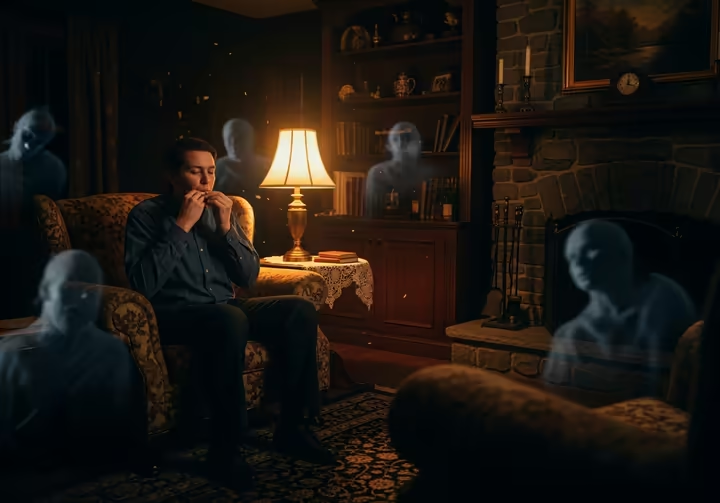
Ever get yelled at for whistling in the house? It’s a classic rule, passed down from grandparents everywhere. But it's not just one rule... it's a whole collection of superstitions from all over the world. People believe a simple tune can cost you your money, summon ghosts, or even start a fire.
The Basic Beliefs
Two Kinds of Trouble
"Don't whistle indoors!" The basic idea is simple: a sharp, whistled tune doesn't belong inside a home. It's seen as a careless sound that can mess up the good vibes of your safe space.
The "bad luck" it causes usually comes in two flavors, financial ruin or a supernatural house guest. The most common belief, especially in Europe, is that you'll "whistle your money away." Your good fortune just gets scared off.
The other, spookier idea is that a whistle is a summons. It’s like sending an open invitation to any nearby demons, ghosts, or other nasty things to come hang out. Some cultures even get specific, warning that whistling attracts snakes or could cause your house to burn down.
Where Did This Idea Come From?
Whistling Your Money Away
In Russia and Eastern Europe, it's all about cash. The saying goes that whistling literally "blows your money away," just like the wind scatters leaves. It's also disrespectful to the domovoy , a friendly house spirit that protects a family's wealth.
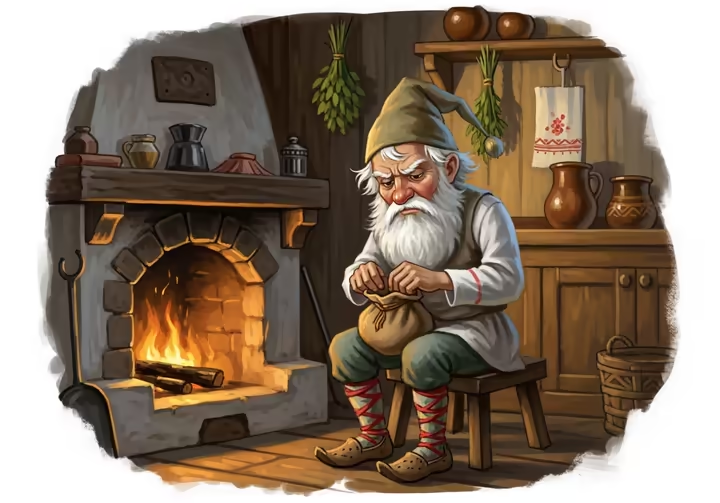
Annoy him, and he might pack his bags... and take your luck with him. This idea probably got extra popular during tough economic times, when people were worried about every penny.
Calling All Ghouls
An even older belief is that whistling is the language of spirits. In ancient Japan, it was used in formal rituals to call on gods. So doing it casually while making tea is a big no-no, you might get a demon instead.
This idea is everywhere. In Lithuania, you're calling the devil. In some Islamic traditions, you're calling the jinn. Witches were also said to whistle to call their familiars or start storms.
Sailors and Storms
Sailors are a superstitious bunch, and they have a huge rule: never whistle on a ship. They believed it was a direct challenge to the weather and could "whistle up a storm." A ship is a lot like a tiny, floating house, so it's easy to see how this belief came ashore.

Sailors brought the superstition from the boat to the living room. The fear of causing a storm at sea became a general fear of causing bad luck at home.
Danger Backstage
The theatre world has its own practical reason to hate whistling. Back in the day, stage crews were often ex-sailors. They used a system of coded whistles to communicate over the noise, signaling when to raise or lower heavy scenery.
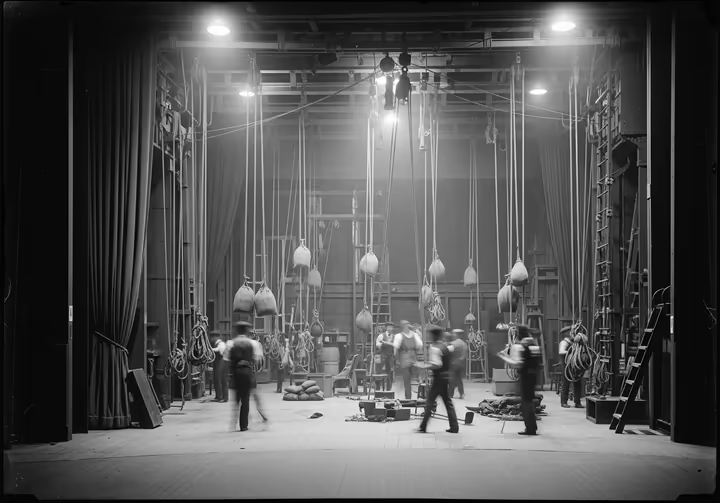
An actor whistling a random tune could be mistaken for a cue. This could lead to a sandbag or a backdrop falling on someone's head. So the rule became simple: no whistling backstage, or else.
Whistling Around the World
Russia and the Baltics
As we've seen, in Russia, it's all about money. But in nearby Lithuania and Latvia, whistling indoors is said to summon the devil. In Estonia, they take it one step further, believing it could cause the house to catch on fire!
Ghosts in Asia
In many parts of Asia, whistling after dark is the real problem. In Japan, a nighttime whistle might attract snakes, thieves, or goblin-like demons. Old stories also suggest criminals used whistles to communicate, so you could be accidentally signaling a real-life baddie.
In China and Korea, the fear is that you'll attract wandering ghosts who might follow you home. Thai and Indian folklore also warns against inviting ghosts and snakes.
Spirits in Africa and a Twist
Nigerian folklore warns that whistling at night can attract snakes and spirits of the dead. But there's a cool exception. Among the Xhosa people of South Africa, whistling isn't a taboo, it's a sacred language used by healers to speak with their ancestors.
In that case, you don't whistle casually because it would be disrespectful. It's a powerful tool, not something to do while you're bored.
The Terrifying El Silbón
Latin America has maybe the scariest version of the whistling taboo. In Venezuela and Colombia, there's a legend of El Silbón , "The Whistler." He's a horrifying ghost cursed to wander the plains carrying his father's bones in a sack (it's a long story).
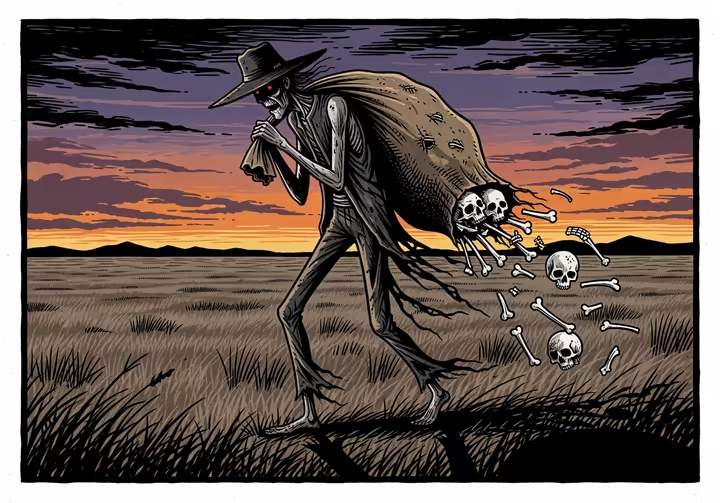
He lets out a chilling whistle, but there's a trick. If the whistle sounds far away, he's right behind you. If it sounds close, you're safe... for now. Hearing his whistle is an omen of death.
So, Why Do We Still Believe It?
It's Just Annoying
Honestly? A loud whistle can be really irritating in a quiet house. It's often easier for a parent or grandparent to say "You'll bring us bad luck!" than to say "Please stop, that sound is driving me insane." It's a clever way to keep the peace without starting an argument.
A Feeling of Control
Life is messy and unpredictable. Superstitions give us a small sense of control over the chaos. Following a simple rule like "don't whistle indoors" makes people feel like they're actively protecting their family from harm. It's a psychological comfort blanket.
Keeping Traditions Alive
These beliefs are also about tradition. When you tell your kid not to whistle inside, you're passing down the same story your grandparents told you. It's a small way to stay connected to your heritage and culture.
An Old Survival Tactic?
Some think the taboo is a "fossil" from our ancient past. Back when humans had to worry about predators, making a loud noise at night was a very bad idea, it told every hungry animal exactly where you were.
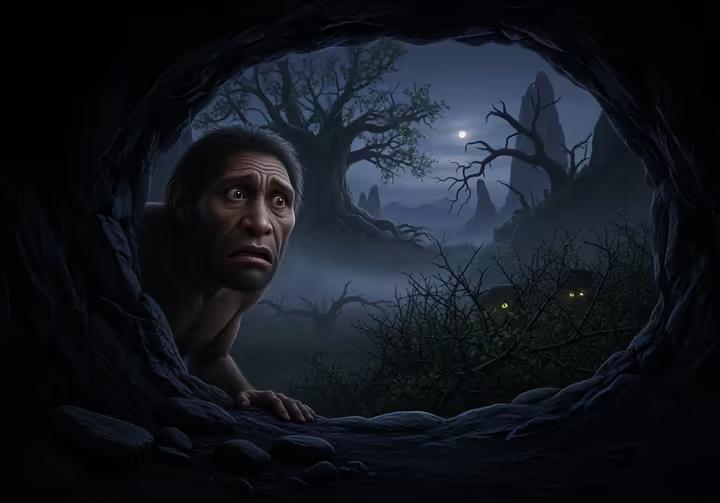
The threat may have changed from bears to demons, but the core behavior, stay quiet and stay safe, remained. The superstition is just a spookier story wrapped around a practical old rule.
Your Questions, Answered
What does whistling in the house mean?
It means bad luck. Usually, it's one of two things: you'll lose all your money, or you'll invite ghosts and spirits into your home.
Why is it worse at night?
Nighttime is traditionally the domain of spirits and spooky things. A whistle cuts through the quiet and acts like a beacon, saying "Hey ghouls, the party's over here!"
Is it rude to whistle indoors?
Pretty much. It can be a loud, jarring sound that disturbs the peace. The superstition is basically a culturally-approved way to tell someone to knock it off.
Where did the superstition come from?
It's a mash-up of ideas. It comes from Russian fears about money, ancient beliefs about spirit languages, sailor taboos about storms, and even old safety rules from the theatre.
Is whistling ever considered good luck?
Yes! Context is everything. Some sailors would whistle softly to encourage a gentle wind on a calm day. And as we saw with the Xhosa people, it can even be a sacred form of communication with ancestors.
Works cited
- Why I glare at you when you whistle indoors: A guide to Ukrainian superstitions - Kaitlin Vitt, https://www.kaitlinvitt.com/ukraine/ukrainiansuperstitions
- Why is whistling in the house seen as dangerous in so many different cultures around the world? Do we know where this superstition originated from ? : r/AskHistorians - Reddit, https://www.reddit.com/r/AskHistorians/comments/w4fsm9/why_is_whistling_in_the_house_seen_as_dangerous/
- en.wikipedia.org, https://en.wikipedia.org/wiki/Whistling#:~:text=In%20Russian%20and%20other%20Slavic,whistling%20outdoors%20is%20considered%20normal.
- Superstitions busted: All about whistling - Daily Sabah, https://www.dailysabah.com/life/2019/07/08/superstitions-busted-all-about-whistling
- 13 Spooky Home Superstitions to Avoid - TowneBank Mortgage, https://townebankmortgage.com/blog/home-tips/13-spooky-home-superstitions-to-avoid/
- Never Whistle at Night (and Other Asian Superstitions) — Banana ..., http://www.banana-mag.com/all-things-azn/2020/4/22/asian-superstitions-issue005
- Lithuanian Superstitions, https://dontveter.com/ec/lithuania-superstitions.pdf
- Whistling - Wikipedia, https://en.wikipedia.org/wiki/Whistling
- Don't Whistle at Night! – A Canadian Superstition - Mysteries of Canada, https://mysteriesofcanada.com/bc/dont-whistle-at-night-a-canadian-superstition/
- Superstitions Any Russian Grandma Swears By - Liden & Denz, https://lidenz.com/superstitions-any-russian-grandma-swears-by/
- Russian Superstitions, https://learnrussianineu.com/russian-superstitions/
- Surprising Russian superstitions that still exist today - Urban ... - Blog, https://blog.urbanadventures.com/surprising-russian-superstitions-that-still-exist-today/
- European Superstitions - Europe Is Not Dead!, https://europeisnotdead.com/european-superstitions/
- Summoning the Spirits – Knot Magick, https://knotmagick101.wordpress.com/2018/12/02/summoning-the-spirits/
- Boating Superstitions | Hubbards Marina | Deep Sea Fishing | Dolphin Watching Tours | John's Pass Madeira Beach FL, https://www.hubbardsmarina.com/boating-superstitions/
- Boating Myths and Superstitions | Sunsail, https://www.sunsail.com/blog/old-sailors-superstitions
- ussconstitutionmuseum.org, https://ussconstitutionmuseum.org/wp-content/uploads/2018/09/List-of-Sailors-Superstitions-Burial-at-Sea.pdf
- The mythology of Whistle project, http://www.whistletheproject.com/2019/08/whistling-mythology.html
- Top 10 theatre superstitions, https://www.capitaltheatres.com/stories/top-10-theatre-superstitions/
- Top Five Superstitions in the Theatre - Lamar University, https://www.lamar.edu/fine-arts-communication/theatre-and-dance/news/top-five-superstitions-in-the-theatre.html
- THEATRICAL SUPERSTITIONS AND SAINTS, http://mchstheatre.weebly.com/uploads/2/3/3/8/23384270/theatrical_superstitions_and_saints.pdf
- Superstitions from around the world | B104 - iHeart, https://b104.iheart.com/content/2017-10-13-superstitions-from-around-the-world/
- 12 Curious Superstitions You'll Find in Asia - Secret Retreats Blog, https://www.secret-retreats.com/blog/general-info/12-curious-superstitions-youll-find-in-asia.html
- The Dangers of Whistling, Clipping, and Shaking - Gwangju News, https://gwangjunewsgic.com/arts-culture/korean-myths/dangers-of-whistling-clipping-shaking/
- en.wikipedia.org, https://en.wikipedia.org/wiki/Whistling#:~:text=In%20Thailand%2C%20it%20is%20believed,household%20to%20experience%20various%20disasters.
- What are some crazy Nigerian myths you still believe? : r/Nigeria, https://www.reddit.com/r/Nigeria/comments/18ico2y/what_are_some_crazy_nigerian_myths_you_still/
- Do Not Whistle at Night: South Africas Strangest Superstitions ..., https://www.nichemarket.co.za/blog/mind-body-soul/sa-strange-superstitions
- CELEBRATING WHISTLING AS AN AFRICAN HERITAGE: FROM ..., https://www.wsu.ac.za/index.php/en/component/content/article/celebrating-whistling-as-an-african-heritage-from-kasi-taxi-ranks-to-cultural-ceremonies?catid=18&Itemid=101
- Latin American Myths and Legends | Latinolife, https://www.latinolife.co.uk/articles/latin-american-myths-and-legends
- Myths and Legends of Latin America - Part 1 - Day Translations Blog, https://www.daytranslations.com/blog/myths-and-legends-of-latin-america-part-1/
- El Silbón - Wikipedia, https://en.wikipedia.org/wiki/El_Silb%C3%B3n
- The Whistler - Latin Folktales - WordPress.com, https://latinfolktales.wordpress.com/2016/02/23/the-whistler/
- What Is Superstitious Behavior And Can It Be A Problem? - BetterHelp, https://www.betterhelp.com/advice/behavior/what-is-superstitious-behavior-can-it-be-a-problem/
- 3 Reasons Why Superstitions Work | Psychology Today, https://www.psychologytoday.com/us/blog/social-instincts/202311/3-reasons-why-superstitions-work
- The Psychology of Rituals and Superstitions - Veritas Newspaper, https://www.veritasnewspaper.org/post/the-psychology-of-rituals-and-superstitions
- Why Superstitions Still Influence Daily Life in the 21st Century | by ..., https://medium.com/@atharvaagni/why-superstitions-still-influence-daily-life-in-the-21st-century-3aad9773f316
- The psychology of superstition - Medical News Today, https://www.medicalnewstoday.com/articles/326330
- The psychology of superstition | inside UNI, https://insideuni.uni.edu/campus-community/psychology-superstition
- Why do cultures from all over the world have superstitions about whistling? - Reddit, https://www.reddit.com/r/AskAnthropology/comments/15jhny4/why_do_cultures_from_all_over_the_world_have/
- The evolution of superstitious and superstition-like behaviour - PMC - PubMed Central, https://pmc.ncbi.nlm.nih.gov/articles/PMC2615824/