Sick on New Year's? An Old Superstition
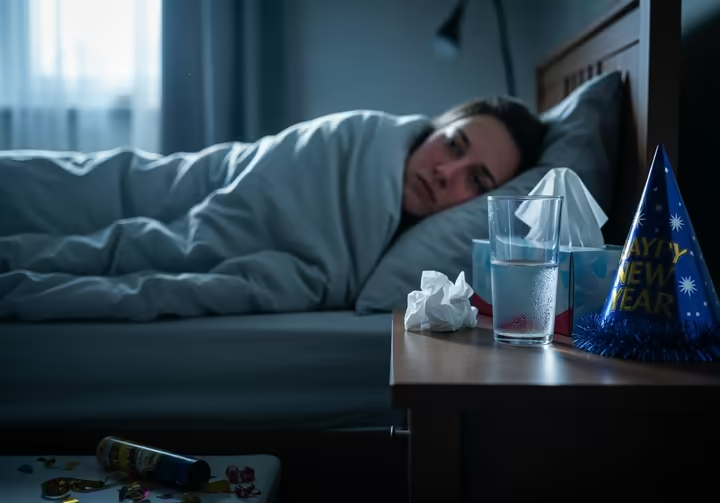
Ever wake up on January 1st with a sniffle and a sense of doom? You're not alone. There's an old, stubborn belief that being sick on New Year's Day means you're in for a whole year of misery. Let's dig into where this idea comes from... and whether you should actually be worried.
The Big Idea: A Sick Start, A Sick Year
What's the Deal?
The superstition is simple: your health on New Year's Day predicts your health for the whole year. It’s a specific version of the old saying, how the new year goes tells how the whole year goes. Your health on this one day is seen as a magical template for the next twelve months.
This creates real anxiety. One person remembered their credit card being stolen on New Year's, followed by a year of ABYSMAL financial problems. That experience made them fear that their current New Year's sickness would likewise predict a year of bad health, showing how coincidence can feel like proof.
Timing, Sickness, and Other Worries
The worry isn't just about New Year's Day itself. People get anxious about being sick right before the new year, wanting to start fresh and healthy. The period of concern can stretch from the days before New Year's Eve right through to the big day.
And it doesn't matter what you've got. A sore throat, food poisoning, pneumonia, or COVID-19, it all counts. The fear isn't about a specific illness, but about the symbolic state of being unwell and setting a pattern of weakness for the year ahead.
Things You Just Don't Do
This superstition also comes with a set of active rules, especially in traditions around the Lunar New Year.
No Doctors or Medicine
In some traditions, taking medicine on the first day of the year is a big no-no. The logic is that taking medicine is like officially admitting you're sick. Doing that on a day that sets precedents is like guaranteeing you'll need medicine all year long.
This can even extend to avoiding doctors, shots, or surgery unless it's a true emergency. It creates a clash between ancient folklore and modern health needs.
Don't Say the 'S' Word
It's not just what you do, it's what you say. In many East Asian cultures, you can't say words with negative meanings, like "sickness," "death," or "pain," during the New Year. The belief is that words have the power to make things happen, especially at such a spiritually charged time.
Fighting Back
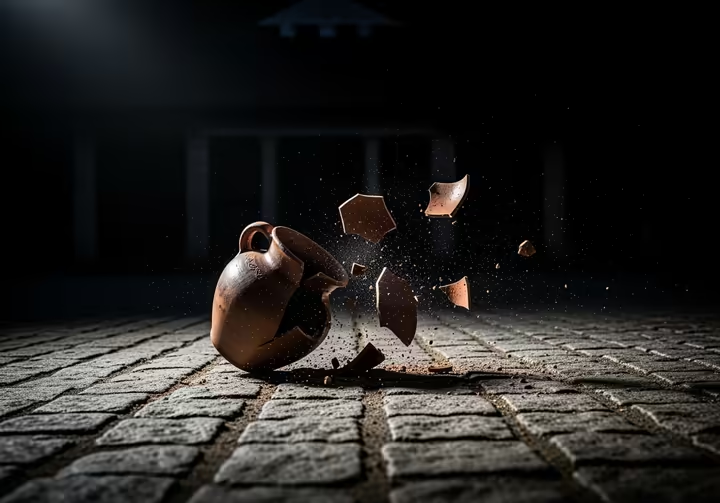
So what if you're already sick? Some traditions have a fix. In parts of China, people who were sick on New Year's Eve would ritually smash their medicine pots (gallipots) after midnight. This symbolic act was meant to drive the illness away and stop it from spoiling the new year's luck.
Where Did This Idea Come From?
The Magic of 'Firsts'
This is a classic example of sympathetic magic, an old idea that like produces like. What you do on New Year's Day is what you'll supposedly be doing all year. This is the simple, magical logic behind the superstition.
The same idea applies to everything else. You stock your cupboards with food and your wallet with money to ensure a prosperous year. You kiss a loved one at midnight to make sure they stick around. Being sick just follows the same pattern, only with a much worse outcome.
Really, Really Old New Year's Parties
New Year's is an ancient ritual, going back more than 4,000 years to Babylon. These early festivals weren't just about a new calendar page, they were about cosmic renewal. They were tied to big events like the harvest or the flooding of the Nile River in Egypt.
The Babylonian festival of Akitu, for example, celebrated a god's victory over a chaos monster, symbolically cleaning up the world for a fresh start. In this context, your personal state, like your health, was a big deal. Even New Year's resolutions started with Babylonians making promises to their gods to get the year off on the right foot.
The Spooky In-Between Time
Folklorists call the New Year's period a liminal time, a spooky threshold between the old and the new. During these moments, the normal rules don't apply, making everything feel both powerful and dangerous. People were thought to be more vulnerable to supernatural forces, both good and bad.
Ancient beliefs said that ghosts and evil spirits were extra active as the year turned. Many New Year's traditions are really just ways to get through this dangerous time safely. Making loud noises with fireworks or banging pots and pans was meant to scare away evil spirits, while opening doors at midnight was to let the old year's bad luck out.
Sickness as a Sign
Before we knew about germs, people often saw sickness as a punishment, a curse, or a sign of divine anger. An illness could be seen as a consequence of sin, so figuring out its spiritual origin was important. Being sick on a spiritually important day like New Year's could be seen as a sign of spiritual weakness or a moral failure.
Oddly enough, modern science has found something similar. The field of epigenetics shows how trauma and environment can leave marks on our genes that get passed down. (A bit like an ancient family curse, but with more science).
Why Our Brains Fall for This
Wanting to Be in Control
The superstition is a classic case of magical thinking, the belief that unrelated events are connected (say, by magic). This kind of thinking gives us an "illusion of control" over a future that's completely uncertain. By following the rules, like not getting sick, people feel they can influence their own fate and reduce their anxiety about the unknown.

Brain Shortcuts That Trick Us
Two brain biases help keep this superstition alive. The first is confirmation bias, our habit of noticing and remembering things that prove what we already believe. If you get sick on January 1st and then catch a cold in July, you'll see it as proof, forgetting all the healthy months in between.
The second is the primacy effect, which makes us give more weight to first events. Being sick on the first day of the year feels much more significant than being sick on a random Tuesday in April. This mental quirk gives the superstition its psychological power.
Trusting Your Gut (Even When It's Wrong)
Psychologists talk about two ways our brains work: slow and logical (System 2) and fast and intuitive (System 1). Superstitions are a total System 1 product. They come from mental shortcuts that feel right on a gut level, even if they're not logical.
- Like Produces Like: The simple idea that being sick now will cause sickness later is an easy leap for our intuitive brain to make.
- Easy to Imagine: When you're actually sick, it's very easy to imagine being sick again. This makes the feared outcome, a year of illness, feel much more probable than it really is.
"I Know It's Silly, But..."
Many people keep up with superstitions even when they know they're not logical. This is called "acquiescence." Your rational brain knows that being sick on January 1st doesn't affect your health in August, but the anxious what if? from your intuitive brain is too strong to ignore. The belief survives because our rational minds often give in to our powerful gut feelings.
How the World Worries on New Year's
East Asia: Keep It Clean
The most detailed health superstitions are tied to the Lunar New Year. Traditions in China and other parts of East Asia focus on keeping things whole and undisturbed. This means taboos against taking medicine, visiting doctors, or even talking about illness.
Other rules follow the same idea. Don't sweep, or you'll sweep away good luck. Don't wash clothes, or you'll wash away fortune. Don't use knives, or you might cut your stream of success.
Europe and North America: Food and First Visitors
In Scotland, the first-footing tradition says the first person to enter your home after midnight sets the luck for the year. A tall, dark-haired man bringing gifts like coal is considered lucky. (This might have started back when blonde strangers were usually Vikings).
Food is also used to attract good fortune. In Germany and the US, pork is lucky because pigs root forward, symbolizing progress. In the American South, eating black-eyed peas (coins) and collard greens (paper money) is a ritual for attracting wealth.
Latin America: Making Your Own Luck
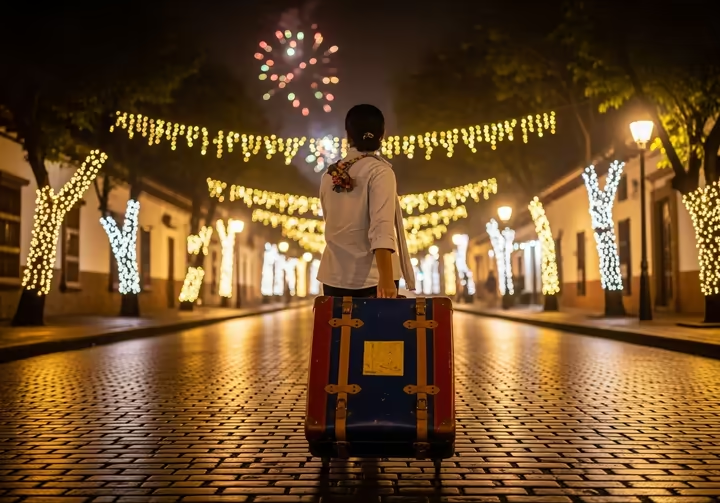
In Latin America, many traditions are about actively creating the future you want. To have a year full of travel, people in Colombia walk an empty suitcase around the block. The color of your underwear is also thought to bring specific results: red for love, yellow for wealth.
The Spanish tradition of eating twelve grapes at midnight, one for each chime of the clock, is also popular. Each grape is a wish for good luck in one month of the coming year.
A Global Guide to New Year's Luck
The following table brings together these different practices. It shows that whether you're eating lentils in Italy or avoiding medicine in China, the goal is the same. You're trying to control your fate at the most powerful turning point of the year.
| Global New Year's Superstitions | ||||
|---|---|---|---|---|
| Ritual/Belief | Culture(s) | Timing | Folkloric Mechanism | Desired Outcome |
| Being sick portends a year of illness | Widespread | New Year's Day | Sympathetic Magic (Like begets like) | Avoidance of a bad omen |
| Taking medicine is taboo | China, East Asia | New Year's Day | Precedent-Setting | Avoidance of a year of sickness |
| Breaking medicine pots | China (some regions) | New Year's Eve | Counter-Magic / Ritual Cleansing | Drive away existing illness |
| First-Footing (Dark-haired male) | Scotland, Northern England | After midnight, Jan 1 | Omen / Contagious Magic | Good fortune for the household |
| Eating 12 Grapes | Spain, Latin America | Midnight, Dec 31 | Sympathetic Magic (1 per month) | Good luck for all 12 months |
| Eating Black-Eyed Peas & Greens | American South | New Year's Day | Sympathetic Magic (resemble coins/money) | Wealth and prosperity |
| Eating Pork / Avoiding Chicken | Germany, USA, various | New Year's Day | Sympathetic Magic (forward vs. backward movement) | Progress, avoidance of setbacks |
| Making Loud Noises (Fireworks, etc.) | Widespread | Midnight, Dec 31 | Apotropaic Magic (Warding off evil) | Protection from evil spirits |
| Wearing Colored Underwear (Red/Yellow) | Latin America, Spain, Italy | New Year's Eve | Sympathetic Magic (Color symbolism) | Attracting love or wealth |
| Walking with an Empty Suitcase | Colombia, Latin America | New Year's Eve | Sympathetic Magic (Mimesis) | Manifesting travel and adventure |
| Smashing Plates | Denmark | New Year's Day | Ritual of License / Luck Accumulation | Good luck (more plates = more luck) |
| Not Sweeping or Cleaning | China, various | New Year's Day | Preservation of Luck | Avoid sweeping away good fortune |
The Superstition Today
Scrolling Through the Anxiety
Online forums like Reddit are the new village square where these old anxieties get shared and amplified. People post about their fear that being sick is a bad omen, looking for someone to either agree with them or tell them to relax. These sites create a feedback loop.
One user updates their post to say their year was, in fact, TERRIBLE, and suddenly everyone's anxiety spikes. On top of that, being sick and stuck at home while scrolling through pictures of everyone else celebrating can make you feel like your year is already starting off wrong.
Pushing Back: The Chronic Illness Community
For people with chronic illnesses, this superstition isn't just silly, it's hurtful. The belief suggests their reality, a life with ongoing illness, is a permanent bad omen or a personal failure. Their very existence clashes with the superstition's core idea.
Rejecting the superstition is an act of resistance. They argue that being sick on New Year's is just another day, not a sign of a ruined year. This is a clash between a traditional folk belief and a modern view that challenges the old definition of "health."
The 'New Year, New You' Industry
The whole fresh start idea is big business. Gyms, diet companies, and self-help gurus all cash in on the feeling that January 1st is a magical time for a total life makeover. While they aren't selling ancient superstitions, they reinforce the idea that how you start the year is incredibly important. This modern marketing gives a little boost to the old magical beliefs about setting a precedent on day one.
The Boring, Scientific Reason You're Sick
It's Not a Curse, It's a Cold
So why do so many people get sick around the holidays? It's not bad luck. Science has a pretty clear answer, it's a perfect storm for germs.
- Stress: The holidays are stressful. All that stress pumps out a hormone called cortisol, which tells your immune system to take a break, making you easier to infect.
- More Germs: Holiday travel means cramming into airports and planes with people from all over. Big indoor parties are also great places for viruses to spread.
- Bad Habits: During the holidays, people tend to sleep less, drink more alcohol, and eat sugary food. All of this weakens your body's ability to fight off infection.
- Cold Air: Winter weather forces everyone indoors into crowded, poorly ventilated spaces. Cold, dry air also dries out your nose, weakening one of your body's first lines of defense against germs.
Mixing Up Cause and Effect
The superstition is a classic mistake in thinking. It takes a predictable biological event and gives it a supernatural cause. People get sick because of all the holiday activities. The superstition then rebrands this very likely outcome as a magical omen for the future.
Belief Can Make It Real (Sort of)
If you truly believe the superstition, it can have real effects. It can create a nocebo effect, where your negative expectations cause real anxiety. You might become hyper-aware of your health, treating every tiny cough as proof that the curse is real.
On the flip side, rejecting the superstition can be empowering. By deciding that your sickness is just a sickness and not an omen, you take back control of your own story. This helps you resist the anxiety the superstition is designed to create.
Works cited
- Is it bad luck to get sick right before the New Lunar Year? : r/YearOfTheDragon2024 - Reddit, https://www.reddit.com/r/YearOfTheDragon2024/comments/1al7mqp/is_it_bad_luck_to_get_sick_right_before_the_new/
- New Year's Day superstitions : r/Appalachia - Reddit, https://www.reddit.com/r/Appalachia/comments/18uk4yn/new_years_day_superstitions/
- New Year's Superstitions and Traditions - Farmers' Almanac, https://www.farmersalmanac.com/new-years-superstitions-traditions
- Creepy New Year Superstitions | The Beaver FM, https://beaver1003.com/mornings/creepy-new-year-superstitions/
- New Year's Day Folklore: Rituals & Superstitions For Good Luck - Icy Sedgwick, https://www.icysedgwick.com/new-years-day-folklore/
- I'm Bringing in the New Year Sick, but That's OK - The Mighty, https://themighty.com/topic/chronic-illness/being-sick-on-new-years-eve/
- Am I the only one who's new year's eve is not going good? : r ..., https://www.reddit.com/r/CasualConversation/comments/rsz749/am_i_the_only_one_whos_new_years_eve_is_not_going/
- Chinese New Year Taboos and Superstitions: 18 Things You ..., https://www.chinahighlights.com/travelguide/festivals/chinese-new-year-taboos.htm
- 8 Things to NEVER do During Lunar New Year - yensa, https://yensa.com/blogs/news/8-things-to-never-do-during-lunar-new-year
- Get lucky this Lunar New Year by avoiding these taboos - CGTN, https://news.cgtn.com/news/334d444e33677a6333566d54/index.html
- Taboos: Avoid These 10 Things During the Chinese New Year, https://chinesenewyear.net/taboos/
- 6 Taboos for Chinese New Year & greetings you need to know - CommonWealth Magazine, https://english.cw.com.tw/article/article.action?id=3615
- Taboos During Chinese New Year - Confucius Institute for Scotland, https://www.confuciusinstitute.ac.uk/taboos-during-chinese-new-year/
- Chinese New Year taboos - NLB, https://www.nlb.gov.sg/main/article-detail?cmsuuid=93731a7e-f34a-4caf-a67f-fd8ba72eb135
- Believing What We Do Not Believe: Acquiescence to Superstitious ..., https://www.apa.org/pubs/journals/features/rev-0000017.pdf
- Do you have any traditions or superstitions about New Year's Day? : r/AskEurope - Reddit, https://www.reddit.com/r/AskEurope/comments/eg4mue/do_you_have_any_traditions_or_superstitions_about/
- A happily superstitious new year - Albany Herald, https://albanyherald.com/features/a-happily-superstitious-new-year/
- New Year Superstitions: Beliefs That Shape the Start of a New Year - The Bromsgrove Standard, https://bromsgrovestandard.co.uk/news/new-year-superstitions-beliefs-that-shape-the-start-of-a-new-year-53489/
- 9 New Year's Superstitions to Kick Off 2024 Right - AARP, https://www.aarp.org/family-relationships/new-years-superstitions/
- How You Start Your Day is How You Start (and End) Your Year - The Eblin Group, https://eblingroup.com/blog/how-you-start-your-day/
- Quote by Annie Dillard: “How we spend our days is, of course, how we spe...” - Goodreads, https://www.goodreads.com/quotes/530337-how-we-spend-our-days-is-of-course-how-we
- How You Start The Year Is How You End It. This is your chance! - YouTube, https://www.youtube.com/watch?v=Ez46yd4LWK8
- New Year's - Traditions, Resolutions & Date | HISTORY - History.com, https://www.history.com/articles/new-years
- New Year festival | Definition, History, Traditions, & Facts - Britannica, https://www.britannica.com/topic/New-Year-festival
- Our Cosmic New Year's Mythology and Rituals | Mythology Matters, https://mythologymatters.wordpress.com/2015/12/30/our-cosmic-new-years-mythology-and-rituals/
- 5 Ancient New Year's Celebrations - History.com, https://www.history.com/articles/5-ancient-new-years-celebrations
- Five New Year's Rituals of Renewal – SAPIENS, https://www.sapiens.org/culture/renewal-rituals/
- Chinese New Year's Connection to Agriculture and Farming - Homestead Gardens, Inc., https://homesteadgardens.com/chinese-new-years-connection-to-agriculture-and-farming/
- Origins Of 12 New Year's Traditions Around The World | Dictionary.com, https://www.dictionary.com/e/new-years-traditions/
- Liminality - Wikipedia, https://en.wikipedia.org/wiki/Liminality
- New Year's Eve Tradition | USC Digital Folklore Archives, https://folklore.usc.edu/new-years-eve-tradition-2/
- new years | USC Digital Folklore Archives, https://folklore.usc.edu/tag/new-years/
- Liminality in Cultural Transition: Applying ID-EA to Advance a ... - Ovid, https://www.ovid.com/journals/rtnp/pdf/10.1891/1541-6577.29.1.25~liminality-in-cultural-transition-applying-id-ea-to-advance
- The Pandemic and the Process of Becoming – SAPIENS, https://www.sapiens.org/culture/pandemic-liminal-state/
- Conceptualising the Biblical View of Curse (Gen. 9:25-27) as a ..., https://scielo.org.za/scielo.php?script=sci_arttext&pid=S1010-99192018000200005
- (PDF) Moral transgression and illness in the Early Modern North - ResearchGate, https://www.researchgate.net/publication/26815321_Moral_transgression_and_illness_in_the_Early_Modern_North
- Ancestral sin - Wikipedia, https://en.wikipedia.org/wiki/Ancestral_sin
- Science Is Proving That Tragic Curses Are Real - Nautilus Magazine, https://nautil.us/science-is-proving-that-tragic-curses-are-real-235689/
- Magical thinking - Wikipedia, https://en.wikipedia.org/wiki/Magical_thinking
- The Psychology of Magical Thinking - Psych Central, https://psychcentral.com/health/magical-thinking
- A confirmation bias in perceptual decision-making due to hierarchical approximate inference - PMC - PubMed Central, https://pmc.ncbi.nlm.nih.gov/articles/PMC8659691/
- Lunar New Year Luck: 10 Taboos to Avoid for Good Fortune | Preferred Hotels, https://preferredhotels.com/where-next/spotlight/lunar-new-year-luck-10-taboos-avoid-good-fortune
- 13 New Year's Superstitions & Traditions with a Pittsburgh Twist, https://www.visitpittsburgh.com/blog/new-years-traditions-superstitions/
- 30 Best New Year's Superstitions and Traditions to Bring Good Luck in 2025, https://www.thepioneerwoman.com/home-lifestyle/g38053426/new-years-superstitions/
- Odd Lang Syne: 7 Creepy New Year's Superstitions That'll Keep ..., https://www.mentalfloss.com/article/653899/creepy-new-year-superstitions
- New Years Eve superstitions - YouTube, https://www.youtube.com/watch?v=uCy14Cev92s
- New Year's Superstitions: Traditions for Good Luck in the New Year - Resilient Stories, https://resilientstories.com/new-years-superstitions/
- Who's also sick on New Years Eve EVERY YEAR? - Reddit, https://www.reddit.com/r/AskReddit/comments/100163i/whos_also_sick_on_new_years_eve_every_year/
- Is anyone else sick on new years eve? : r/offmychest - Reddit, https://www.reddit.com/r/offmychest/comments/18vjo2k/is_anyone_else_sick_on_new_years_eve/
- Is Your Social Media Making You SICK? - Erin Sponaugle, https://www.erinsponaugle.com/post/is-your-social-media-making-you-sick
- Ask the Expert: New Year's resolutions and health myths - News at IU, https://news.iu.edu/live/news/28114-ask-the-expert-new-years-resolutions-and-health
- Why Do We Get Sick During the Holidays? - RWJBarnabas Health, https://www.rwjbh.org/blog/2024/december/why-do-we-get-sick-during-the-holidays-/
- Holiday Illnesses: Why Do You Get Them? - Healthline, https://www.healthline.com/health-news/why-we-are-sick-during-holidays
- How to make it through the holidays without getting sick - Piedmont Healthcare, https://www.piedmont.org/living-real-change/how-to-make-it-through-the-holidays-without-getting-sick
- "The Science Of Why You Get Sick During The Holidays" - Whitney Akers | Mount Sinai, https://www.mountsinai.org/about/newsroom/2017/the-science-of-why-you-get-sick-during-the-holidays-whitney-akers