Bad Luck? The Superstition of Wearing a Dead Person's Clothes
You've cleared out your late grandma's closet. Now what? Some folks feel a cozy connection wearing her old sweaters, while others get the major creeps. Let's figure out why the idea of wearing a dead person's clothes freaks us out so much, a story that starts with ancient plagues and ends in your local thrift store.
The Original Reason: Germs (and Bad Smells)
Long before anyone knew about germs, people had a simple rule: if it stinks, it's probably deadly. They called this "miasma", basically, bad air from gross stuff like rotting things or swamps. They believed this poisonous vapor caused diseases like the plague and cholera... and they weren't entirely wrong.
People also knew sickness spread by touch. An Italian doctor in the 1500s figured out that "fomites", a fancy word for objects, could carry disease. Clothing and bedding were considered especially dangerous, basically little germ-ferries.
This wasn't just a theory. During the Great Plague of 1665, doctors wore those creepy beaked masks stuffed with herbs to block the miasma. In places like Yemen, they used to burn second-hand clothes at the border, terrified they might belong to dead people.

Then, scientists like Louis Pasteur discovered germs, proving the "bad air" theory wrong. But the fear of contaminated clothes stuck around. It just changed its name from "disease" to "bad luck" or "negative energy."
So, for centuries, avoiding a dead person's clothes was a smart survival move. The original reason (fear of pathogens) faded, but the habit of avoidance became a powerful cultural superstition. It’s a gut feeling that outlived its scientific purpose.
What Different Cultures Do
While the fear is widespread, what people actually do with the clothes is all over the map. These customs are tied to a culture's beliefs about the soul, the afterlife, and the line between the living and the dead. Each tradition has its own way of handling things.
Major Religions
In Hinduism , wearing a deceased person's clothes is a big no-no. Garments are believed to hold a person's karma and negative energy. To free the soul for its journey ( moksha ), the clothes are usually burned or buried.
Islam focuses on charity. Keeping the clothes is thought to bring sadness, so they are washed and given to the poor. This act helps the needy and is believed to benefit the deceased in the afterlife.
Judaism is mostly okay with reusing clothes... except for shoes. There's a strong taboo against wearing a dead person's shoes, maybe from an old fear of diseases spread by sweat, or because of spooky dreams about the dead wanting them back. So, clothes are fine, but the shoes get tossed or sold.
Christianity doesn't have a strict rule, leaving it up to personal comfort. Most often, clothes are donated to charity as a way to honor the person's memory by helping others.
In Buddhism , the goal is to let go of worldly stuff to end suffering. Clinging to old clothes runs counter to this idea. Donating or disposing of them fits the philosophy best.
Japan's indigenous Shinto religion views death as a source of spiritual pollution, or kegare . This impurity can cling to objects, especially clothes. Reusing them is a big problem unless they're ritually purified.
Indigenous and Folk Traditions
Beyond major religions, there are plenty of other fascinating customs.
In North America , practices among Indigenous peoples vary a lot. Some groups, like the Navajo, traditionally burned all possessions to sever the spirit's ties to the world. Others, like the Lakota, would bury a person in their finest clothes, believing they'd need them in the spirit world.
In Latin America , Nahua traditions in Mexico see death as a transformation. Clothing and jewelry are used in offerings ( ofrendas ) to help the soul on its journey. It's not about wearing them, but using them as ritual tools.
Funerals in many West African societies are huge celebrations. The deceased is dressed in their best clothes for all to see. Mourners wear special symbolic cloths, like adinkra cloth, to show their relationship to the person.
In traditional East Asian folk religions, especially in China, people burn the deceased's clothing. They also burn paper replicas of money, houses, and cars. This act is a metaphysical transfer, sending the items to the spirit world for the ancestor to use.
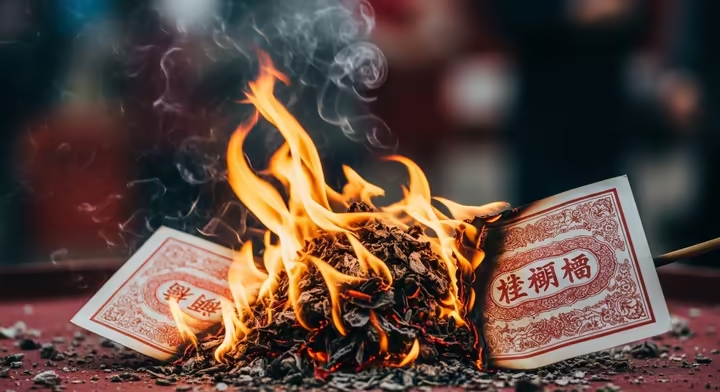
Finally, in parts of Oceania , keeping belongings is just too painful. Among the Tiwi people of Australia, it's thought to trap the spirit and prolong grief. So, everything is ritually destroyed, burned, buried, or thrown into the sea, to help everyone move on.
| Culture/Religion | Core Belief | Handling of Deceased's Clothing | Rationale |
|---|---|---|---|
| Hinduism | Clothes carry negative energy and karma, and the soul must be freed from earthly attachments. | Strictly prohibited to wear. Usually burned or buried. | To release the soul from material bonds and cleanse items of negative spiritual residue. |
| Islam | Keeping clothes is an ill omen. Charity (sadaqah) benefits the deceased. | Washed and donated to the poor. | To avoid sorrow and generate spiritual merit for the departed soul. |
| Judaism | Useful items shouldn't be destroyed, but shoes carry a specific danger (sakana). | Clothing is okay to wear, but shoes are a strict taboo and must be discarded. | Shoe taboo comes from fears of contagion and mystical interpretations. Other clothing is reused to avoid waste. |
| Christianity | No strict rule. Emphasis on compassion and helping the living. | Commonly donated to charity or given to family. | To honor the deceased's memory through goodwill and to help those in need. |
| Buddhism | Emphasis on impermanence and detachment from material things. | No explicit rule, but donation or disposal is favored. | To practice non-attachment and recognize the fleeting nature of material life. |
| Shinto | Death is a source of spiritual pollution (kegare) that must be contained. | Reuse is problematic due to contamination. Deceased is dressed in a white burial kimono. | To avoid spreading the impurity of death to the living. |
| Navajo | Fear of the lingering ghost (chindi) and its harmful influence. | All personal possessions, including clothing, are traditionally burned. | To completely sever the spirit's connection to the world and protect the living. |
| Akan (West Africa) | Funerals are communal celebrations. Clothing is a key part of ritual expression. | Deceased is dressed in their finest clothes. Mourners wear special funerary cloths. | To honor the deceased, express social ties, and provide for them in the spirit world. |
| Chinese Folk Religion | The afterlife mirrors earthly life, and ancestors need provisions. | Burned as a ritual offering to be sent to the spirit world. | To ensure the ancestor is well-equipped and doesn't become a dissatisfied ghost. |
| Tiwi (Oceania) | Keeping possessions is too painful and tethers the spirit to the world. | All personal belongings are ritually destroyed. | To help the living grieve and allow the spirit to move on. |
The Spooky Part: Bad Vibes and Ghosts
The core supernatural idea is that clothes soak up a person's "essence" or "energy." When you wear them, that energy transfers to you. It's basically a spiritual germ theory.
This can go wrong in a few ways. You might absorb the person's bad luck or unresolved karma. Or, wearing the clothes could be a bad omen, inviting a similar fate, especially if the death was tragic.
Some even believe the ghost might get angry and haunt you for stealing its stuff. This fear shows up in urban legends about a woman who buys a second-hand dress only to hear a spectral voice demanding it back.
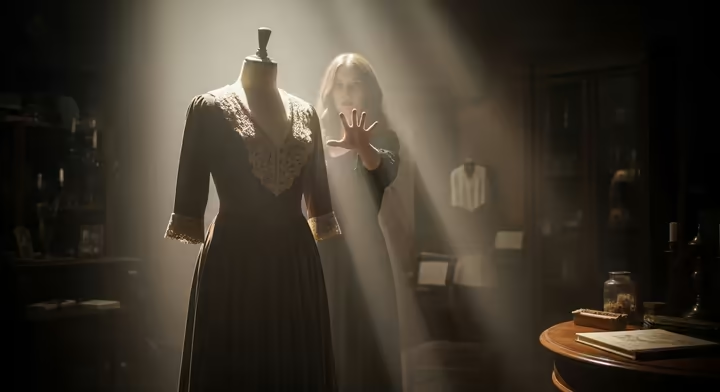
Not all clothes are equally spooky. The most feared are the ones someone was wearing *when they died*. These are seen as uniquely soaked in the trauma of the event, which is why hospitals have strict protocols and usually treat them as clinical waste.
Your Brain on Grief (and Gross-Outs)
Even if you don't believe in ghosts, you might still feel weird about wearing a dead person's clothes. Psychologists call this the "contagion heuristic", the gut feeling that an object's essence can be transferred through touch. It’s why you wouldn’t want to wear Hitler’s sweater, the ick-factor is real.
This feeling is tied to the primal emotion of disgust , a protective mechanism that evolved to help us avoid disease. A dead person's clothes remind our brain of bodies, decay, and death, which triggers that "ew, get away" feeling.
This also pokes at our deepest fear, our own mortality. "Terror Management Theory" suggests that reminders of death make us anxious. To cope, we often cling more strongly to comforting cultural beliefs, including superstitions.
Clothes are also a "second skin" tied to our identity. For a grieving person, a loved one's shirt can be a powerful comfort, a tangible link to them. This creates a paradox, the clothes are both a comforting relic and a creepy reminder.
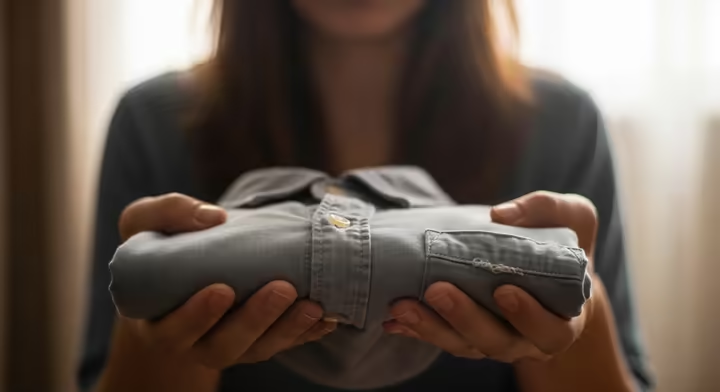
The superstition acts as a psychological firewall. It creates a clear boundary between the realms of the living and the dead, helping the mind manage the overwhelming reality of loss. It's a cognitive tool for grief, not just a fear of ghosts.
Thrift Stores, Heirlooms, and Getting Rid of Bad Juju
Today, this ancient taboo clashes with modern life. We're all about thrifting and sustainable fashion, which is basically a giant market of... well, dead people's clothes. The term "dead white man's clothing," used for second-hand imports in some parts of Africa, says it all, it's a mix of dark humor and pragmatism.
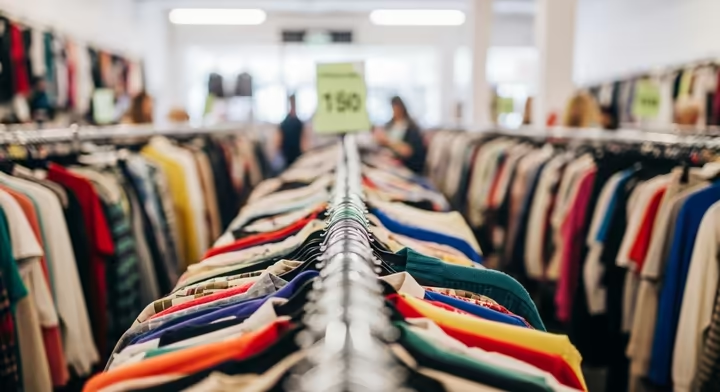
On the flip side, many people *want* to wear a loved one's clothing as a meaningful act of remembrance. For many, wrapping themselves in a memory provides a profound comfort that outweighs any old superstition.
Jewelry is a different story. Unlike porous clothing, jewelry is made of durable materials like metal and stone that resist decay. It symbolizes permanence and legacy, so it's more likely to be a cherished heirloom than a contaminated object.
If you're still a bit spooked but want to reuse an item, people have developed all kinds of cleansing rituals. You can wash it in salt water, pass it through the smoke of herbs like sage, or leave it out in the sun or moonlight. Even a simple act like washing the clothes with vinegar is sometimes recommended.
The modern world has split the superstition. In an anonymous thrift store, the fear is abstract and easily dismissed. But when the clothes belong to your own loved one, their history is powerful, and the choice to wear them becomes intensely personal.
So... Is It Bad Luck?
The final verdict? There is no universal "bad luck" in wearing a dead person's clothes. The danger, which was once very real in the form of germs, is now almost entirely symbolic. The power isn't in the fabric, but in the meaning we weave into it.
Ultimately, the choice is a personal one. It's one of the final, intimate acts in our relationship with the deceased. Whether we burn, donate, or wear these garments, our actions help us manage our deepest fears and draw the line between the world of the living and the memory of the dead.
Works cited
- Miasma theory – Knowledge and References - Taylor & Francis, https://taylorandfrancis.com/knowledge/Medicine_and_healthcare/Miscellaneous/Miasma_theory/
- Miasma theory - Wikipedia, https://en.wikipedia.org/wiki/Miasma_theory
- VIPEROUS BREATHINGS: THE MIASMA THEORY IN EARLY MODERN ENGLAND by Lindsay Pannell, https://wtamu-ir.tdl.org/bitstreams/01ef8baf-9160-48e7-938a-726237e5e998/download
- From miasmas to germs: a historical approach to theories ... - InfezMed, https://www.infezmed.it/media/journal/Vol_20_1_2012_9.pdf
- Fashion and The Plague 1665 - Robes Most Resistant and Clothing Most Infectious, https://www.showstudio.com/projects/fashion-in-a-time-of-crisis/fashion-and-the-plague-1665-robes-most-resistant-and-clothing-most-infectious
- What's Wrong With Wearing Dead People's Clothes? - Junkee, https://archive.junkee.com/whats-wrong-with-wearing-dead-peoples-clothes/22722
- A review of clothing microbiology: the history of clothing and the role of microbes in textiles - PMC, https://pmc.ncbi.nlm.nih.gov/articles/PMC7876606/
- Public Health Implications of Retailer Resale of Returned Textile Clothing Merchandise - ScholarWorks | Walden University Research, https://scholarworks.waldenu.edu/cgi/viewcontent.cgi?article=7709&context=dissertations
- When filth became dangerous: the miasmatic and contagionistic origins of nineteenth-century cleanliness practices among Swedish provincial doctors - PubMed Central, https://pmc.ncbi.nlm.nih.gov/articles/PMC12041326/
- Why should you never wear a dead person's clothes? - Quora, https://www.quora.com/Why-should-you-never-wear-a-dead-persons-clothes
- Why You Should Not Wear Dead Person's Clothes - Last Journey Funeral Services, https://www.lastjourney.in/blog/why-you-should-not-wear-dead-person-clothes/
- Why is wearing a deceased person's clothes is considered inauspicious in Hinduism, https://www.timesnownews.com/spiritual/why-is-wearing-a-deceased-persons-clothes-is-considered-inauspicious-in-hinduism-article-100163019
- What to do With a Deceased Person's Things? Should one use ..., https://www.timesnownews.com/spiritual/know-what-to-do-with-the-material-things-of-a-deceased-person-article-109893077
- Chapter 32: The items of the deceased – Shulchanaruchharav.com, https://shulchanaruchharav.com/halacha/chapter-32-the-items-of-the-deceased/
- You Can't Give Away a Dead Person's Shoes | USC Digital Folklore Archives, https://folklore.usc.edu/you-cant-give-away-a-dead-persons-shoes/
- Wearing a deceased's shoes - Mi Yodeya - Stack Exchange, https://judaism.stackexchange.com/questions/20637/wearing-a-deceaseds-shoes
- Buddhist funeral services and death rites - Funeral Partners, https://www.funeralpartners.co.uk/help-advice/arranging-a-funeral/types-of-funerals/buddhist-funerals/
- How to Dress Appropriately for a Buddhist Funeral, https://www.alifegrad.com/buddhist-funeral-attire-dressing-respectfully-to-honor-the-departed/
- What Color Not To Wear At A Buddhist Funeral? - Nirvana Memorial Garden Singapore, https://nirvanamemorialsg.com/what-color-not-to-wear-at-a-buddhist-funeral/
- Shinto - Japan Guide, https://www.japan-guide.com/e/e2056.html
- What does the Shinto religion believe happens to them after death? - Quora, https://www.quora.com/What-does-the-Shinto-religion-believe-happens-to-them-after-death
- Understanding Shinto | Beliefs | eCondolence.com, https://www.econdolence.com/learning-center/religion-and-culture/shinto/understanding-shinto
- Japanese Death, Funeral, and Grief Rituals: A Cultural Exploration, https://joe-l-maldonado.mykajabi.com/blog/Japanese%20Death,%20Funeral,%20and%20Grief%20Practices:%20A%20Cultural%20Exploration
- Culture and Death: Native American Heritage | Alive Hospice, https://www.alivehospice.org/news-events/culture-and-death-native-american-heritage/
- Symbolic Embellishment of Ritual Textiles Used in Native American Burial Mounds - UNL Digital Commons, https://digitalcommons.unl.edu/cgi/viewcontent.cgi?referer=&httpsredir=1&article=1354&context=tsaconf
- Nahuas People: funeral rites - Spiritualité Autochtone, https://peuplesautochtones.com/nahuas-people-funeral-rites/
- Día de Muertos: History and Practices of Mexico's Day of the Dead - BSN Voices, https://voices.britishschool.nl/2023/10/27/dia-de-muertos-history-and-practices/
- Rebozo de Luto: the Aromatic Mourning Shawl of Mexico - Death Scent, https://deathscent.com/2021/11/01/rebozo-de-luto/
- Funeral Rites Across Different Cultures: West African Traditions - Woodlawn Cemetery, https://www.woodlawn.org/blog/funeral-rites-across-different-cultures-west-african-traditions/
- Clothed in symbols: wearing proverbs - Digital Collections, https://quod.lib.umich.edu/p/passages/4761530.0007.004/--clothed-in-symbols-wearing-proverbs?rgn=main;view=fulltext
- Cultural Actions toward the Dead in Selected Cultures in Africa - Digital Commons @ Andrews University, https://digitalcommons.andrews.edu/cgi/viewcontent.cgi?article=1237&context=jams
- Chinese death rituals - Singapore - NLB, https://www.nlb.gov.sg/main/article-detail?cmsuuid=a3bfaffd-f823-4cf1-80a0-888db820bf1d
- Female Pollution-in Chinese Society - MacSphere, https://macsphere.mcmaster.ca/bitstream/11375/10258/1/fulltext.pdf
- The Chinese Approach to Death and Dying, https://inelda.org/the-chinese-approach-to-death-and-dying/
- Joss paper - Wikipedia, https://en.wikipedia.org/wiki/Joss_paper
- sangfu 喪服, mourning dress - Chinaknowledge, http://www.chinaknowledge.de/History/Terms/sangfu.html
- Destroyal of the personal belongings of the deceased On bone and flesh type of objects: Elaborating Hertz in Australia - OpenEdition Journals, https://journals.openedition.org/jso/812?file=1
- Was anyone ever told that it was bad luck to wear the clothing of a deceased loved one?, https://www.reddit.com/r/NoStupidQuestions/comments/zjq0op/was_anyone_ever_told_that_it_was_bad_luck_to_wear/
- Traditional European Folklore on Death and Dying | Nonfictioness, https://nonfictioness.com/folklore/traditional-european-folklore-on-death-and-dying/
- DEATH AND AFTERWARDS - Folklore.ee, https://www.folklore.ee/folklore/vol8/mds.htm
- Receiving a Deceased into Care | The Eternal Debate, https://www.theeternaldebate.com/receiving-a-deceased-into-care/
- Contagion heuristic - Wikipedia, https://en.wikipedia.org/wiki/Contagion_heuristic
- Disgust: the disease-avoidance emotion and its dysfunctions - PMC, https://pmc.ncbi.nlm.nih.gov/articles/PMC3189352/
- (PDF) Disgust, creatureliness and the accessibility of death‐related ..., https://www.researchgate.net/publication/227792899_Disgust_creatureliness_and_the_accessibility_of_death-related_thoughts
- Mortality salience and helping intentions: mediating role of search ..., https://pmc.ncbi.nlm.nih.gov/articles/PMC11985808/
- Mortality Salience Increases Belief in a Just World but Not Schadenfreude in Response to a Natural Disaster Affecting a Religious Out-group, https://openpsychologyjournal.com/VOLUME/7/PAGE/64/
- Wearing My Dead Husband's Clothes Is My Way Of Letting Him Live ..., https://www.elle.com/uk/life-and-culture/a41789417/wearing-my-dead-husbands-clothes/
- Wearing Dead People's Clothing | Ravishly, https://www.ravishly.com/wearing-dead-people-s-clothing
- The Relationship Between Social Class and Supernatural Belief Kassidy Noble Shepherd University - suweb.site, https://media.suweb.site/2017/12/Noble_Kassidy-THESIS.pdf
- Socio-cultural factors related to the tendency toward superstition among women living in the suburbs of Yazd - DOAJ, https://doaj.org/article/bb370be64ed2401f8e63b5f93ddc4b4e
- How Baby Boomers and Millennials Differ in Terms of Death Taboo - farewells magazine, https://farewells.co.uk/how-baby-boomers-and-millennials-differ-in-terms-of-death-taboo/
- Death Superstitions and Traditions in Appalachia | Blind Pig and The Acorn, https://blindpigandtheacorn.com/death-superstitions-and-traditions-in-appalachia/
- DISCOVER THE TRUTHS ABOUT THE USED CLOTHING INDUSTRY THE NEWS - Secondary Materials and Recycled Textiles, https://www.smartasn.org/SMARTASN/assets/File/pressreleases/Discover%20the%20Truths%20about%20the%20Used%20Clothing%20Industry%20.pdf
- Two Reasons to Shop at Deceased Estates Clearance Sales Events, https://josebarbara.com/2023/05/12/two-reasons-to-shop-at-deceased-estates-clearance-sales-events/
- Selling deceased family members things - Buying things from deceased people : r/Ebay - Reddit, https://www.reddit.com/r/Ebay/comments/17b2tku/selling_deceased_family_members_things_buying/
- Signs And Superstitions Associated With Rings - Harlem World Magazine, https://www.harlemworldmagazine.com/signs-and-superstitions-associated-with-rings/
- 11 Wedding Rings Superstitions & Engagement Ring Myths, https://www.shiningdiamonds.co.uk/blog/wedding-rings-myth-legend-superstition-or-true-life
- How to Cleanse Your Jewelry of Negative Energies - Anandasoul, https://anandasoul.com/blogs/blog/how-to-cleanse-your-jewelry
- CLEANSING 101 - The Hoodwitch, https://www.thehoodwitch.com/blog/2014/10/10/a-thrift-queens-guide-to-clearing-cleansing
- How to Cleanse an Object for Magical or Ritual Use - Tree Of Life Shoppe, https://treeoflifeshoppe.com/blogs/tree-of-life-blog/how-to-cleanse-an-object-for-magical-or-ritual-use
- How To Cleanse and Charge Ritual Tools and Objects - Original Botanica, https://originalbotanica.com/blog/how-to-cleanse-and-charge-ritual-tools-and-objects
- Rituals for Cleansing and Charging Your Clothing - KimonoGirl, https://realkimonogirl.com/blogs/news/rituals-for-cleansing-and-charging-clothing-energy
- How to cleanse an object? (Beginner) : r/witchcraft - Reddit, https://www.reddit.com/r/witchcraft/comments/owldvt/how_to_cleanse_an_object_beginner/
- Cleansing spell after death of a family member? : r/elderwitches - Reddit, https://www.reddit.com/r/elderwitches/comments/14rih8r/cleansing_spell_after_death_of_a_family_member/
- Precautions for Handling and Disposal of Dead Bodies (The 10th edition) - Centre for Health Protection, https://www.chp.gov.hk/files/pdf/grp-guideline-hp-ic-precautions_for_handling_and_disposal_of_dead_bodies_en.pdf
- guidelines for the handling of dead bodies for owners / operators of funeral home establishments, https://www.moh.gov.jm/wp-content/uploads/2020/04/Guidelines-on-the-Handling-ofBodies_V3.1.pdf
- The Responsible Textile Recovery Act of 2024 | Buchalter - JDSupra, https://www.jdsupra.com/legalnews/the-responsible-textile-recovery-act-of-1389080/
- (PDF) Death Costume and Ritual Lament in Greek Folk Tradition (19 th -20 th Century), https://www.researchgate.net/publication/341233533_Death_Costume_and_Ritual_Lament_in_Greek_Folk_Tradition_19_th_-20_th_Century
- Cat Over the Coffin | USC Digital Folklore Archives, https://folklore.usc.edu/cat-over-the-coffin/
- Funeral Procession | Dartmouth Folklore Archive, https://journeys.dartmouth.edu/folklorearchive/2018/11/14/funeral-procession/
- Folklore Archives, https://folklore.berkeley.edu/folklore-archives
- History of medical clothing - Medka, https://www.medka.eu/en/blogs/blog/medical-clothing-history
- Role of healthcare apparel and other healthcare textiles in the transmission of pathogens: a review of the literature - PMC - PubMed Central, https://pmc.ncbi.nlm.nih.gov/articles/PMC7132459/
- Fashion Historian Explores Clothing & Contagious Disease - YouTube, https://www.youtube.com/watch?v=UzdcMqipMIY
- The Evolution of Mourning Wear - The Journal of Antiques and Collectibles, https://journalofantiques.com/features/the-evolution-of-mourning-wear/
- Beyond Black: Exploring the History of Funeral Attire - Toledo Memorial Park, https://toledomemorialpark.com/blog/2023/12/21/beyond-black-exploring-the-history-of-funeral-attire
- The Cultural Significance of Mourning Clothes - Farewelling, https://www.myfarewelling.com/article/the-cultural-significance-of-mourning-clothes
- The History of Mourning Dress and Attire in the West | Eterneva, https://www.eterneva.com/resources/mourning-dress
- Mourning Fashion - UM Clements Library, https://clements.umich.edu/exhibit/death-in-early-america/mourning-fashion/
- Evolution of American Funerary Customs and Laws | In Custodia Legis, https://blogs.loc.gov/law/2022/09/evolution-of-american-funerary-customs-and-laws/
- Mourning Traditions and Fashion History - Natania Barron, https://nataniabarron.com/2021/10/12/mourning-traditions-and-fashion-history/
- Mourning Clothing Medieval Customs - Timeless Fashion Hub, https://timelessfashionhub.com/fashion-history/medieval-era/mourning-clothing-medieval-customs/
- Pitt Rivers Museum Body Arts | Death - University of Oxford, https://web.prm.ox.ac.uk/bodyarts/index.php/body-arts-and-lifecycles/death.html
- For Whom The Dead Dress - Occam's Razor, http://occamsrazorwwu.org/for-whom-the-dead-dress
- Death Rituals, Ceremonies & Traditions Around the World | Eterneva, https://www.eterneva.com/resources/death-rituals
- Death, Burial & the Afterlife in the Ancient Celtic Religion - World History Encyclopedia, https://www.worldhistory.org/article/1707/death-burial--the-afterlife-in-the-ancient-celtic/
- Clothes of the Deceased « Ask The Rabbi « - Ohr Somayach, https://ohr.edu/explore_judaism/ask_the_rabbi/ask_the_rabbi/4450
- The Shiva Dress: When Mourning Comes | Hadassah Magazine, https://www.hadassahmagazine.org/2018/01/26/shiva-dress-mourning-comes/
- The Basics of Kriah, or Tearing a Piece of Clothing | My Jewish Learning, https://www.myjewishlearning.com/article/the-basics-of-kriah-or-tearing-a-piece-of-clothing/
- How do people dress for funeral ? : r/HongKong - Reddit, https://www.reddit.com/r/HongKong/comments/19ehw3r/how_do_people_dress_for_funeral/
- What should you wear to a Buddhist funeral? - Quora, https://www.quora.com/What-should-you-wear-to-a-Buddhist-funeral
- Shinto: Periods of Mourning - eCondolence.com, https://www.econdolence.com/learning-center/religion-and-culture/shinto/shinto-periods-of-mourning
- How to cleanse an article of clothing? : r/WitchesVsPatriarchy - Reddit, https://www.reddit.com/r/WitchesVsPatriarchy/comments/171us4c/how_to_cleanse_an_article_of_clothing/
- How to cleanse jewelry that has been passed on : r/witchcraft - Reddit, https://www.reddit.com/r/witchcraft/comments/137iqiq/how_to_cleanse_jewelry_that_has_been_passed_on/
- When you die in a hospital : r/askfuneraldirectors - Reddit, https://www.reddit.com/r/askfuneraldirectors/comments/1e89fs3/when_you_die_in_a_hospital/
- Providing care after death | For Professionals - Marie Curie, https://www.mariecurie.org.uk/professionals/palliative-care-knowledge-zone/care-after-death
- How long did you guys wait before disposing of, or repurposing their clothes..? - Reddit, https://www.reddit.com/r/GriefSupport/comments/18d4yi6/how_long_did_you_guys_wait_before_disposing_of_or/
- Is it wrong to wear the deceased's clothes at their funeral? : r/NoStupidQuestions - Reddit, https://www.reddit.com/r/NoStupidQuestions/comments/122hljm/is_it_wrong_to_wear_the_deceaseds_clothes_at/
- [Behavior / Clothing / Clothing] What is a funeral taboo? | Fswa-Net, https://fswa-net.com/news/behavior-clothing-clothing-what-is-a-funeral-taboo
- Is it okay to use something that belonged to a now dead person? - Reddit, https://www.reddit.com/r/ask/comments/1619wgr/is_it_okay_to_use_something_that_belonged_to_a/
- Very Superstitious: The Legends and Stories Behind Lucky Jewelry, https://quickjewelryrepairs.com/articles/lucky-jewelry/
- Indigenous Perspectives on Death and Dying - CPD University of Toronto, https://www.cpd.utoronto.ca/endoflife/Modules/Indigenous%20Perspectives%20on%20Death%20and%20Dying.pdf
- Korean traditional funeral - Wikipedia, https://en.wikipedia.org/wiki/Korean_traditional_funeral
- Why Are White Clothes Worn During Hindu Funerals? Symbolism Explained, https://www.asianindianfuneralservice.com/blog/blog/why-are-white-clothes-worn-during-hindu-funerals-symbolism-explained
- Corpses and cloth: (Chapter 4) - Buddhist Funeral Cultures of Southeast Asia and China, https://www.cambridge.org/core/books/buddhist-funeral-cultures-of-southeast-asia-and-china/corpses-and-cloth/1D8ED66E65754C29AA857AE0A0F35039
- Pacifica Cultural Conversations - Metropolitan Memorial Parks, https://www.metropolitanmemorialparks.com.au/resource-hub/pacifica-cultural-conversations
- Clothing of Oceania | Encyclopedia.com, https://www.encyclopedia.com/fashion/encyclopedias-almanacs-transcripts-and-maps/clothing-oceania
- The matter of the unfetish : Hoarding and the spirit of possessions | HAU: Journal of Ethnographic Theory: Vol 4, No 3, https://www.journals.uchicago.edu/doi/10.14318/hau4.3.013
- An Ethnographic Study of Collaborative Fashion Consumption: The Case of Temporary Clothing Swapping - ResearchGate, https://www.researchgate.net/publication/358800705_An_Ethnographic_Study_of_Collaborative_Fashion_Consumption_The_Case_of_Temporary_Clothing_Swapping
- Conceptualizing Spirit Possession: Ethnographic and Experimental Evidence | Request PDF - ResearchGate, https://www.researchgate.net/publication/227653739_Conceptualizing_Spirit_Possession_Ethnographic_and_Experimental_Evidence
- Death And Dying Sociology - AceNet Hub, https://www4.acenet.edu/death-and-dying-sociology
- Sociological Death Definition - AceNet Hub, https://www4.acenet.edu/sociological-death-definition
- Our Ancestors and Superstitions About Death - Genealogy Courses, https://www.traceyourpast.com/articles/our-ancestors-and-superstitions-about-death
- Can jewelry bring bad luck? - Orzyla, https://www.orzyla.com/en/can-jewelry-bring-bad-luck/
- Ten jewellery superstitions, myths, and old wives tales you need to know - Lorel Diamonds, https://www.loreldiamonds.com/blog/10-jewellery-superstitions-myths-tales-you-need-to-know
- Funeral practices and burial customs in the Philippines - Wikipedia, https://en.wikipedia.org/wiki/Funeral_practices_and_burial_customs_in_the_Philippines
- Any superstitions surrounding body treatment, affecting the afterlife?? : r/mythology - Reddit, https://www.reddit.com/r/mythology/comments/17kcvv8/any_superstitions_surrounding_body_treatment/
- 18 Superstitions About Death | Psychology Today, https://www.psychologytoday.com/us/blog/understanding-grief/202008/18-superstitions-about-death
- Mourning - Society Islands, Heva ceremony - The Australian Museum, https://australian.museum/about/history/exhibitions/death-the-last-taboo/mourning-society-islands-heva-ceremony/
- How Australian communities dispose of their dead - YouTube, https://www.youtube.com/watch?v=cuYEidGKR4s
- Ceremonies: Funerals, Senufo-Tagba of West Africa, Online Exhibits, Exhibits, Spurlock Museum, U of I, https://www.spurlock.illinois.edu/exhibits/online/senufo/ceremonies2.html
- Bereavement and Mourning (Africa) - 1914-1918 Online, https://encyclopedia.1914-1918-online.net/article/bereavement-and-mourning-africa/
- Day of Skulls: a Bolivian ritual - SA Expeditions, https://www.saexpeditions.com/blog/post/day-of-skulls-a-bolivian-ritual
- Settling the Dead: Funerals, Memorials and Beliefs Concerning the Afterlife - Living in the Chinese Cosmos | Asia for Educators, https://afe.easia.columbia.edu/cosmos/prb/journey.htm
- Superstitions: A Culturally Transmitted Human Behavior - Scientific & Academic Publishing, http://article.sapub.org/10.5923.j.ijpbs.20180804.02.html
- Superstition in health beliefs: Concept exploration and development - PMC, https://pmc.ncbi.nlm.nih.gov/articles/PMC7266200/
- Diversity in Dying: Death across Cultures – Nursing Care at the End of Life, https://milnepublishing.geneseo.edu/nursingcare/chapter/diversity-in-dying-death-across-cultures/
- The Protestants' attitude towards death - Musée protestant, https://museeprotestant.org/en/notice/the-protestants-attitude-towards-death/
- (PDF) Death, Defilement, and the Sacred: Navigating the Pollution–Purity Dichotomy in Ancient Indian Funerary Rites - ResearchGate, https://www.researchgate.net/publication/392729949_Death_Defilement_and_the_Sacred_Navigating_the_Pollution-Purity_Dichotomy_in_Ancient_Indian_Funerary_Rites
- Pollution in the Folk Belief System - The University of Chicago Press: Journals, https://www.journals.uchicago.edu/doi/pdfplus/10.1086/203590
- Ritual Ecologies: Analyzing the Environmental Impact and Cultural Sustainability of Death Practices Across Civilizations through - EPJ Web of Conferences, https://www.epj-conferences.org/articles/epjconf/pdf/2025/13/epjconf_icetsf2025_01063.pdf
- On Grief, Land, & Ritual | Acres of Ancestry Initiative, https://acresofancestry.org/on-grief-land-ritual/
- Sales/Use Tax - Missouri Department of Revenue - MO.gov, https://dor.mo.gov/taxation/business/tax-types/sales-use/
- COVID-19 - Control and Prevention - Postmortem Care Workers and Employers | Occupational Safety and Health Administration, https://www.osha.gov/coronavirus/control-prevention/postmortem-care
- The Infection Hazards of Human Cadavers - ISID, https://isid.org/guide/infectionprevention/the-infection-hazards-of-human-cadavers/
- Death Ritual: Anthropological Perspectives Milton Cohen - Queensborough Community College, https://www.qcc.cuny.edu/socialSciences/ppecorino/DeathandDying_Text/Death%20Ritual.pdf